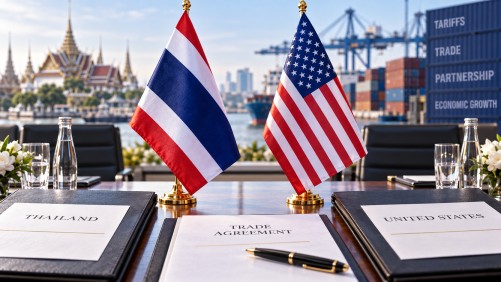
Thailand is intensifying its efforts to negotiate a reciprocal trade agreement with the United States to shield its exporters from potential increases in tariffs. Discussions are progressing on unresolved matters, although no specific deadline for finalizing the Agreement on Reciprocal Trade (ART) has been set, according to Thai officials.
Prime Minister Anutin Charnvirakul is expected to address trade negotiations and tariff issues with U.S. President Donald Trump. Currently, Thailand faces a 12.5% tariff under a Section 301 measure connected to imports produced using forced labor. Additionally, an ongoing U.S. investigation concerning structural excess production capacity, initiated in March 2026, could lead to further duties on Thai exports. This investigation also targets other major trading nations.
In response, Thai authorities have submitted data to challenge the U.S. concerns, arguing that the production capacity in various key industries is higher than previously recognized by American officials. They are aiming to update the U.S. assessment to reflect this more accurately. The objective is to secure tariff treatment on par with regional competitors like Malaysia and Indonesia.
The proposed ART is intended to enhance market access and offer greater certainty for Thai exporters, though the precise tariff conditions are still under negotiation. The agreement would also address American concerns regarding trade barriers, investment, and market access in Thailand. Any finalized deal would require approval through Thailand’s domestic procedures before implementation.