
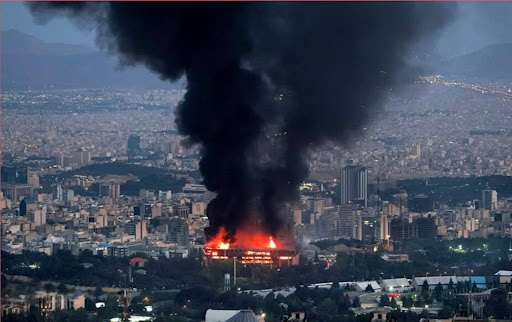
Iran issued its most expansive military threat yet on Saturday, warning that it would attack any energy or economic installation across the Gulf region that maintained ties to American companies. The threat came as the joint US-Israeli offensive against Iran entered its third week, showing no signs of slowing. Iranian forces simultaneously launched missile salvoes at Israel and the UAE, striking near Fujairah’s critical oil facilities and forcing a partial suspension of operations at the port.
US planes had bombed Kharg Island, Iran’s principal oil export hub, on Friday in what President Trump described in public comments as a near-total demolition of the facility. Further waves of US strikes continued throughout Saturday across Iranian territory. Trump said he was not yet ready to consider a deal with Iran and called on warships from multiple nations to head to the Strait of Hormuz. He wrote on Truth Social that China, France, Japan, South Korea, and the UK should contribute naval forces.
Israeli warplanes conducted dozens of raids aimed at dismantling Iran’s missile systems and weakening its security infrastructure. At least 15 people were killed when an Israeli strike hit a factory in the central Iranian city of Isfahan. Iran’s military confirmed ongoing attacks against Israel as well. US Defence Secretary Pete Hegseth said Iranian leaders were in hiding and claimed that Mojtaba Khamenei, Iran’s recently installed supreme leader, had been injured in an earlier Israeli strike. Iranian officials acknowledged the injury but described it as minor.
The economic consequences of the war were becoming increasingly severe. The Strait of Hormuz carries roughly one-fifth of global oil and gas, and its continued closure was pushing prices sharply higher. Experts warned that oil could reach $150 per barrel if Kharg Island’s export capacity were fully eliminated. Trump had previously held back from destroying oil facilities but threatened to reverse that position if Iran continued blocking the strait. The deployment of additional US marines and the USS Tripoli to the region signalled growing US military commitment.
The war’s humanitarian toll was staggering and growing. Between 1,400 and 1,800 Iranians had reportedly been killed under sustained bombing, with residents describing unrelenting strikes. Thirteen Israelis and around 20 people across the Gulf had also died. More than 800 people had been killed in Lebanon amid Israeli strikes on Hezbollah, and 850,000 had been displaced. The US embassy in Baghdad was struck overnight, and six US troops died in a military aircraft crash in western Iraq. Analysts urged a rapid diplomatic resolution before the conflict caused irreversible economic and humanitarian damage worldwide.